Validation#
Survey submissions can be validated server-side with SurveyJS’s own validation engine, compiled into a small standalone binary. This is the counterpart to the client-side validation that SurveyJS performs in the browser — the browser checks improve the user experience, the server check is the security boundary (client-side validation can always be bypassed; see Security).
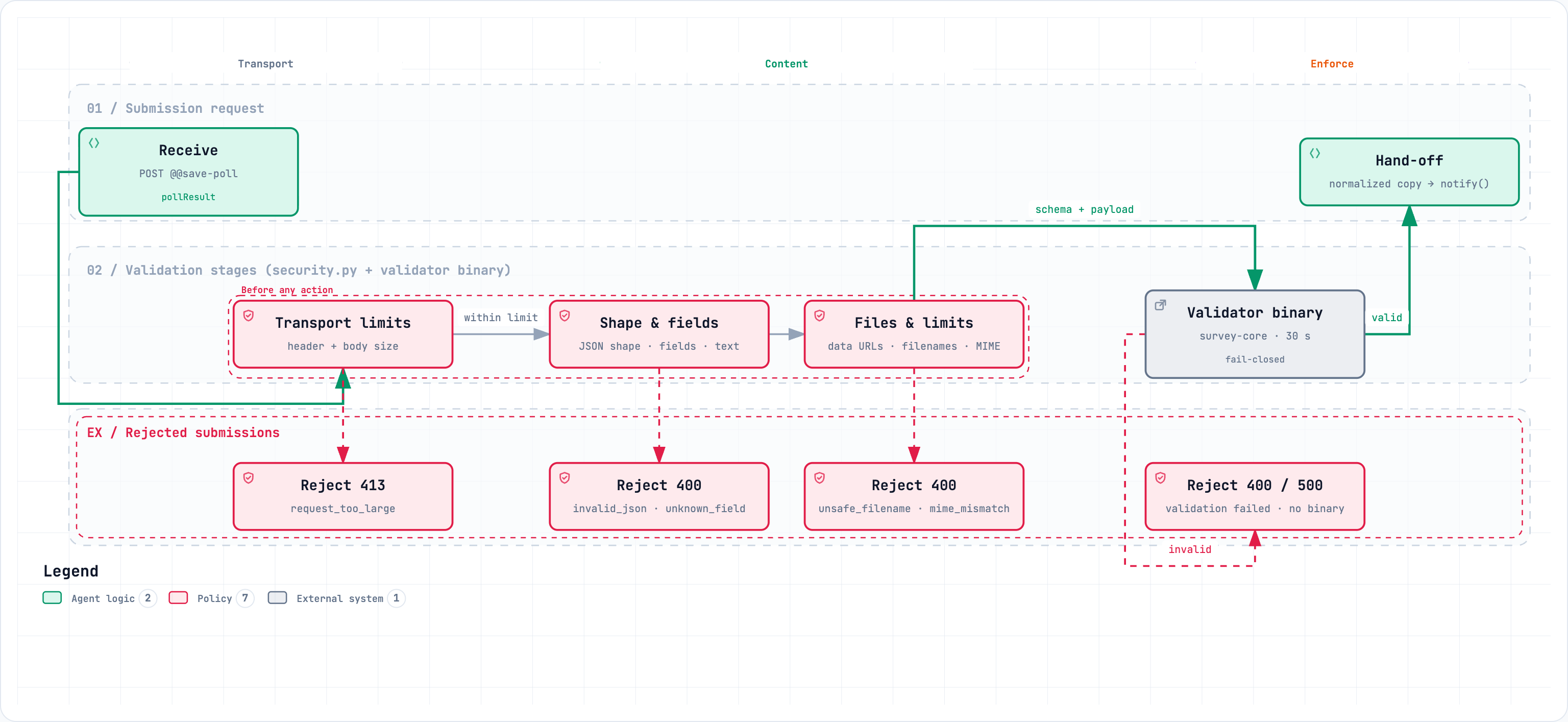
The pipeline is ordered and fail-closed: size limits are enforced before any JSON is parsed, every content check runs on a copy of the payload, and a rejected submission never reaches a subscriber, the storage or any action.
Pre-validation before event dispatch and storage#
The Python boundary validator runs for every new @@save-poll submission,
independently of the optional external SurveyJS validator. It runs after
request/access checks and before notify(), persistence, mail delivery or
configured external POST processing. A rejected submission cannot reach any
subscriber or post-submit action.
The order is deliberate:
Transport limits:
Content-Lengthand the actual request body are checked against the survey’s maximum payload size. Oversized input is rejected with HTTP 413 before JSON parsing.JSON shape:
pollResultmust be valid JSON whose top-level value is an object. Arrays, strings, numbers andnullare rejected. Nested values are recursively copied and limited to JSON scalar, list and object types.Schema fields: field names are collected from the active form schema. Unknown fields and orphaned comment fields are rejected. SurveyJS comment suffixes use the configured
commentPrefix. Themissing_requiredcheck remains available viaenforce_required_fields=Truebut is disabled by default for compatibility.Text safety: recursive string checks reject control characters, obfuscated
javascript:andvbscript:schemes, dangerous markup, script/SVG/iframe/object/embed elements andon*event-handler attributes. Ordinary text such as2 < 3remains valid.Data URLs: non-file data URLs are limited to Base64 PNG and JPEG images. The encoding is strictly decoded and malformed or unsupported URLs are rejected.
File structure: file values must be lists of objects with string filename, MIME type and content members. Unsupported members are omitted from the normalized result rather than persisted.
Filenames: names are normalized to Unicode NFC before validation and storage. Path separators, traversal, control characters, quotes and markup-oriented characters are rejected while international names remain supported.
MIME and content: a restrictive MIME allowlist is enforced. SVG and
application/octet-streamare rejected. The declared MIME must match the data URL, and decoded bytes must match the expected magic bytes for PNG, JPEG, GIF, WebP, PDF, RTF, ZIP and Office formats.Resource limits: file count and decoded file-size limits are enforced independently of the total request limit.
Canonical hand-off: validation returns a normalized deep copy and never mutates the caller’s original payload. Only this copy is passed to the optional external validator and, after success, to downstream processing.
Validation failures return the JSON contract:
{"isSuccess": false, "error": "<code>", "field": "<optional-field>"}
The field member is omitted for errors without a specific field. Failures
use deterministic error codes, warning-level application logging and a
zopyx.surveyjs.audit entry containing only reason, field,
origin and remote_addr. Submission contents, tokens and secrets are
not logged. Single-use embed/trusted tokens are consumed only after
pre-validation succeeds.
Validation error codes#
payload_not_object/invalid_form_schemaThe submission or active form schema is not a JSON object.
unknown_field/invalid_comment_prefixA field is not in the schema, a comment is orphaned, or
commentPrefixis invalid.missing_requiredA required question is absent or empty. This check is disabled by default; when enabled,
Falseand0remain valid values.invalid_comment_length/comment_too_longA comment limit is invalid or the submitted comment exceeds it.
control_character/dangerous_url/html_markupUnsafe text, URL schemes, markup or event-handler attributes were found.
invalid_valueA generic value has an unsupported type.
invalid_file/too_many_files/unsafe_filenameFile structure, file count or filename validation failed.
disallowed_mime_type/mime_mismatchThe MIME type is not allowed or does not match the data URL.
invalid_data_url/invalid_base64/file_too_largeFile data is malformed or exceeds its decoded byte limit.
invalid_file_contentMagic bytes or text encoding do not match the declared file type.
Server-side validation (external SurveyJS binary)#
The per-survey setting Force Server Side Validation (Form Settings tab,
default: on) runs every submission through the external validator
binary before the submission is stored or any action is executed. The
binary is a compiled executable built from validate.mjs (SurveyJS
survey-core 3.x) — no Node.js runtime is needed on the Plone host.
Validation pipeline#
@@save-pollreceives the submission and passes the hardening checks (payload size, access mode, authenticity token).When Force Server Side Validation is enabled, the submission payload and the current form schema are written to a temporary directory and the validator binary is invoked with the two JSON files.
The binary loads the schema into a SurveyJS model, applies the payload via
survey.data, runssurvey.validate()and collects the per-question error details. The result is written as JSON:{"valid": true|false, "errors": [{"name", "title", "codes": [...], "messages": [...]}]}. Each error carries a stable machine-readablecodesentry (e.g.required,email,numeric) plus a human-readablemessagesentry — survey-core’s empty default texts (notably for required questions) are mapped to readable strings.The Python wrapper maps the outcome:
valid: true— the submission proceeds (stored, mailed, POSTed).valid: false— the submission is rejected with HTTP 400 (external_validation_failed) and the per-question error details are returned in the response body; nothing is stored.binary missing → HTTP 500
external_validator_missing; the validator timed out (30 s) → HTTP 500external_validator_timeout; the binary crashed or produced no result → HTTP 500external_validator_error.
When the setting is off, submissions are accepted based on the client-side validation only (plus the hardening checks) — faster, but the server trusts the client.
Binary location and building#
Source and build tooling:
src/zopyx/surveyjs/data_validation/(validate.mjs,Makefile,package.json,deno_build.py).At runtime the wrapper expects the platform binary next to the module (
validate-linux/validate-mac) and builds it automatically when it is missing or was produced from a differentvalidate.mjsor toolchain pin (manifest based, not age based). The Deno release is pinned indeno_build.pyand its archive digest and executable version are verified before compilation.Manual builds with bun or deno, cross-compilation via Docker, and packaging notes: see Installation → “External survey validation (deno / bun)”.
CLI usage of the validator itself: Data Validation (CLI).
Payload limits#
The per-survey Max size payload (MB) setting (default 1 MB, minimum 1)
is enforced before validation: requests larger than the limit are
rejected with HTTP 413 (request_too_large / json_too_large)
and are never parsed or validated. This protects the validator (and the
rest of the pipeline) from oversized or malicious payloads.
Error responses#
Common error codes returned by @@save-poll:
400—missing_poll_result,invalid_payload,invalid_json,missing_form_schema,external_validation_failed(with per-question details)403—invalid_origin,invalid_token,token_already_used(embed submissions)413—request_too_large,json_too_large500—external_validator_missing,external_validator_error(binary not found or failed to produce a result)
Logging#
Validation emits INFO-level logs with the submission hash, schema and payload sizes, the validator return code and the elapsed time, so failed or slow validations are traceable in the Plone logs (see Security for the log-monitoring guidance).